Week Eight: Period Three Implies Chaos
This week we dove into Li and Yorke’s 1975 paper “Period Three Implies Chaos.”
1 In Class
We continued discussing Li and Yorke’s paper “Period Three Implies Chaos”.
As a reminder, the goal of looking at this paper is to understand the statement of the main result (Theorem 1), the ideas of the proof of the first part of Theorem 1 (proof of T1), and the proof in Appendix 1 that a point of period 5 does not guarantee a point of period 3.
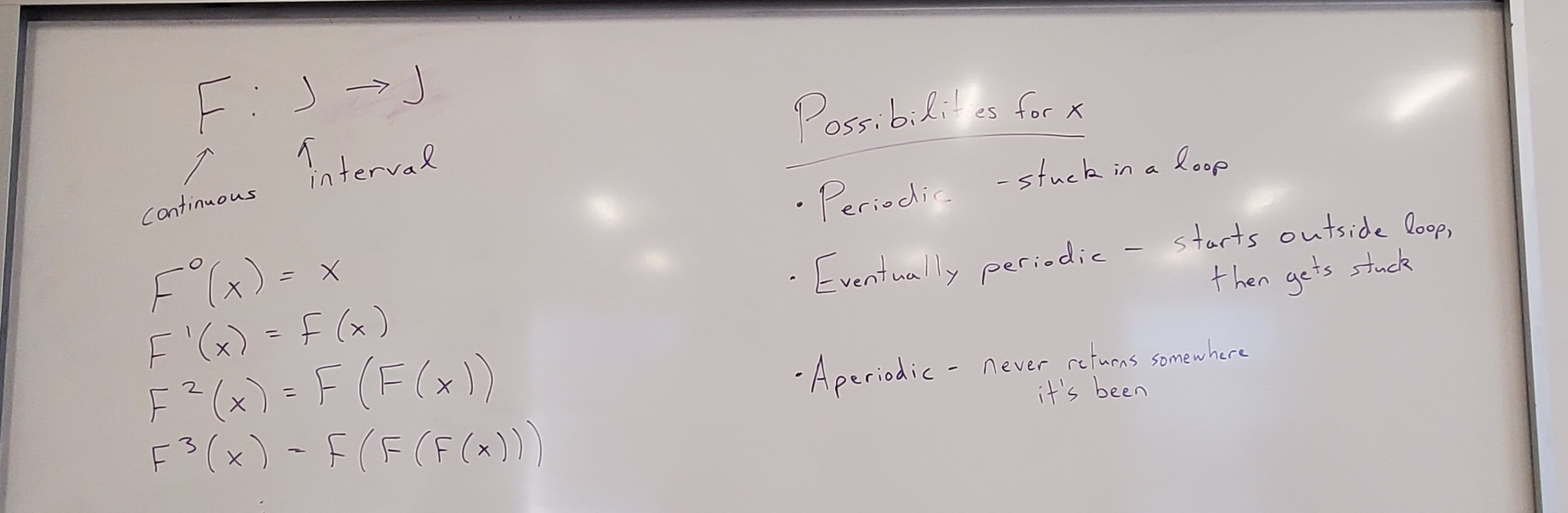
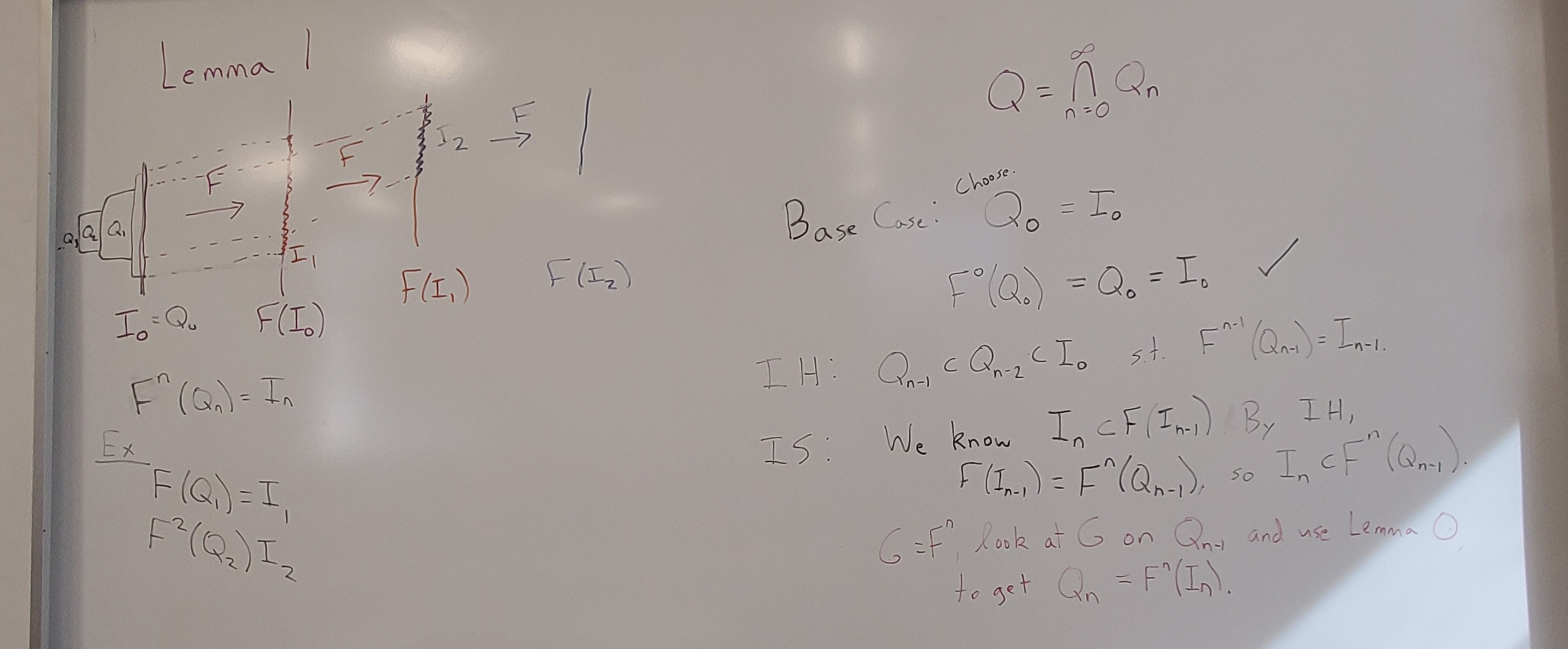
In class, we talked through the general idea of the statement of the theorem as well as the statements and proofs of Lemmas 0 and 1.
![Whiteboard discussion of Li and Yorke paper. Left side shows the condition on the points a, b, c, and d, especially the d <= a < b < c case. One image shows that this is a cycle of period 3 when a = d. The right side of the board illustrates Lemma 0. A vertical line segment on the left is the interval I, and a longer line on the right is the real numbers. The image of I under a map G is the real line, which is shown with dotted lines from the endpoints of I out to the "endpoints" of the line representing the real numbers. Inside the real numbers, an interval I1 is shaded in blue. Its endpoints are labeled G(p) and G(q), and there are dotted lines back to points in the interval I labeled p and q. In part of the area between them, a smaller interval is shaded and labeled Q. The main idea of the theorem is that if we have a closed interval in the range, it can come from a closed interval in the domain. The reason the closed interval Q in the domain isn't necessarily [p,q] is shown in another drawing on the board, with a desired interval marked and two points marked that are at the edges of that interval. Not everything in the continuous squiggly line between them stays within the interval, but if you move in from each side, there's a smaller chunk where everything does stay between them.](images/20260320_102926.jpg)
2 Homework 7 – Due Friday, Mar. 27 by the start of class
Both of the options below introduce Smale’s horseshoe map, mentioned in the Li and Yorke paper between Lemma 1 and Lemma 2.
📖 Reading Option 1: How We Can Make Sense of Chaos
📺Watching Option 2: Smale’s Horseshoe Map
Submit your work to the HW 7 assignment on Blackboard!