Week Nine: Wrapping Up Chaos
This week we wrapped up our discussion of Li and Yorke’s 1975 paper “Period Three Implies Chaos.”
1 In Class
We continued discussing Li and Yorke’s paper “Period Three Implies Chaos”.
As a reminder, the goal of looking at this paper is to understand the statement of the main result (Theorem 1), the ideas of the proof of the first part of Theorem 1 (proof of T1), and the proof in Appendix 1 that a point of period 5 does not guarantee a point of period 3.
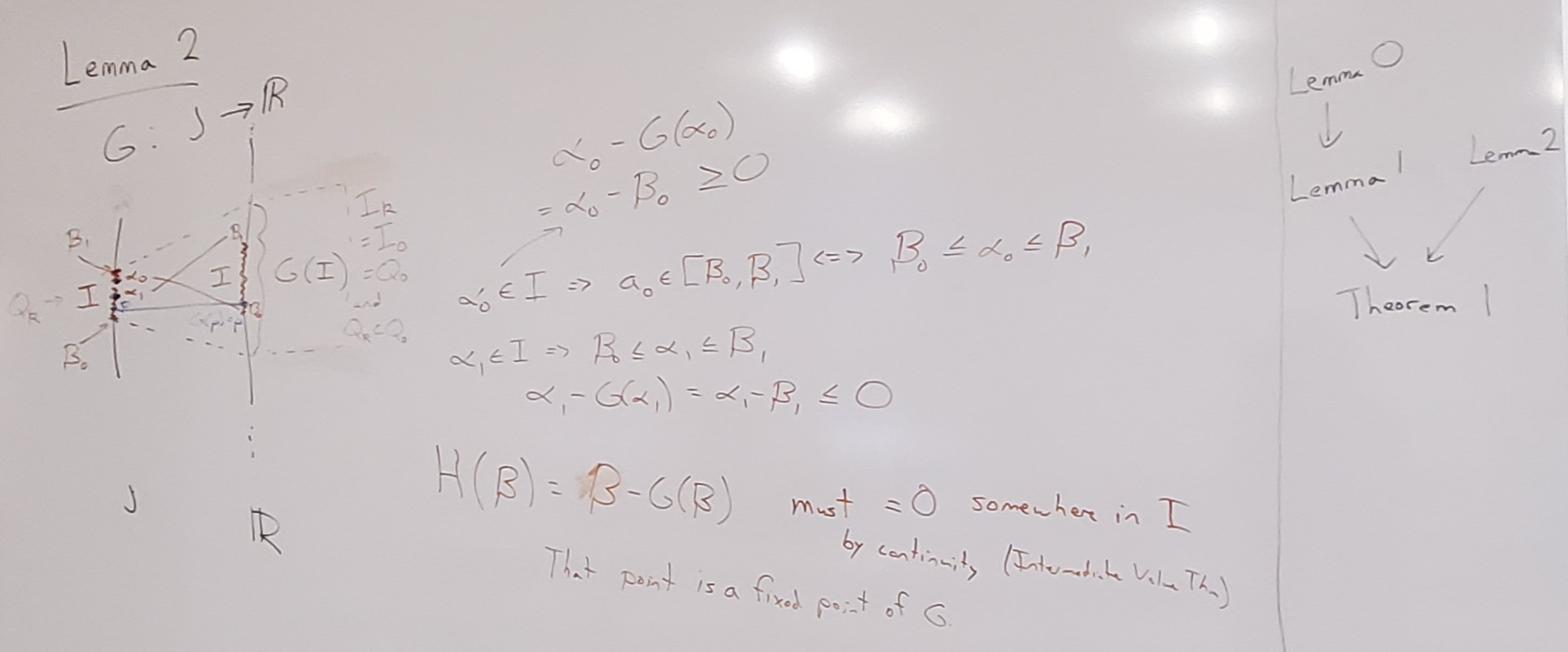
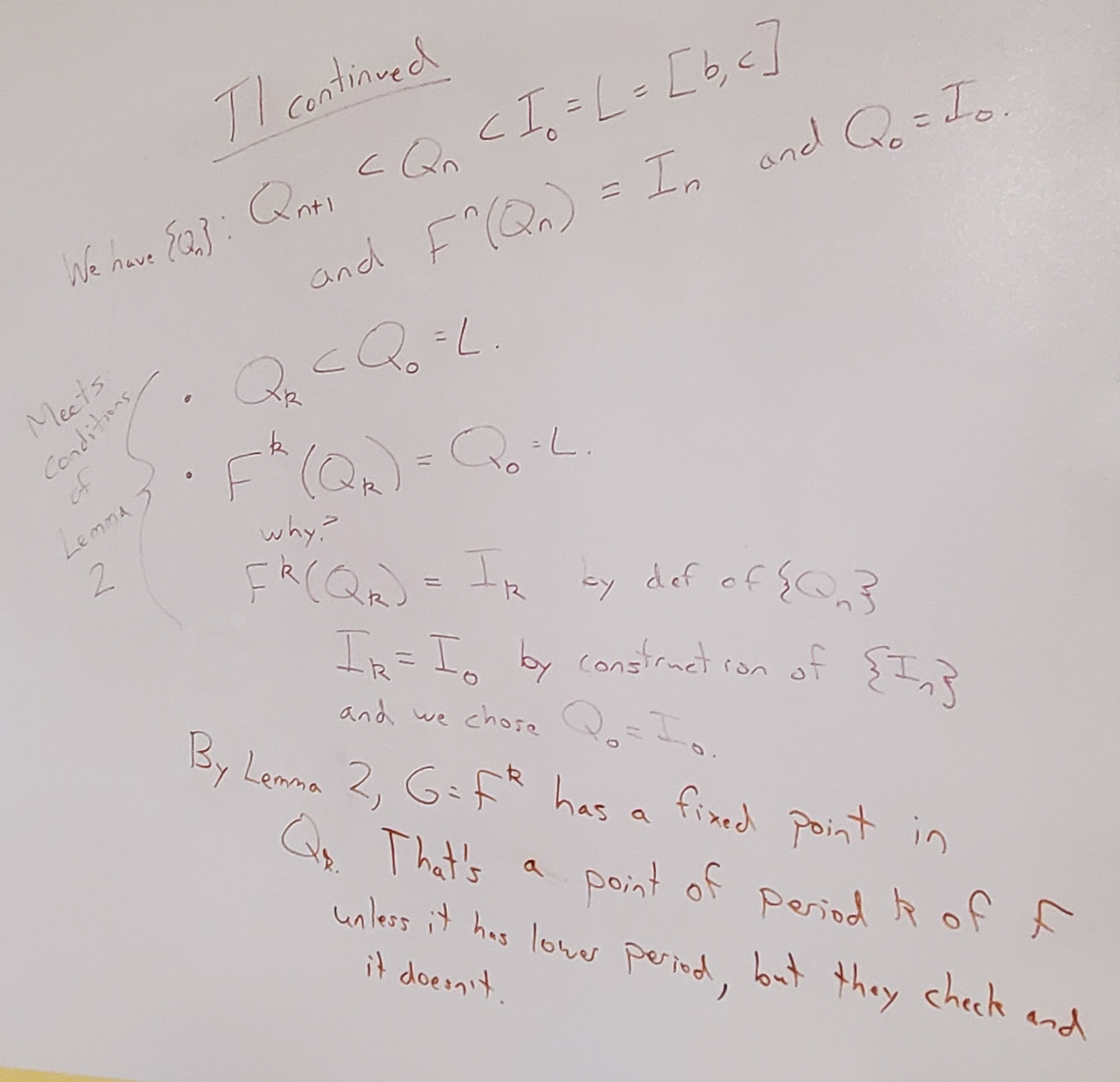
In Week 8 we had talked through the statements and proofs of Lemma 0 and Lemma 1. This week, we talked through the statement and proof of Lemma 2 as well as the proof of Theorem 1.
We closed by talking about the limits on weather forecasting due to chaos, with references to changes in forecasting skill over time but a limit of about two weeks.
![For Theorem 1, our notation and assumptions are: d <= a < b< c where a is in J, F(a) = b, F(b) = c, F(c) = d. Let K = [a,b] and L=[b,c]. We want to show that for a positive integer k, there is a point in J of period k under map F. In the proof, if k= 1, let I_n = L. if k> 1, let I_n = L for n = 0 through k-2, then I_k-1 = K, and then after that have a cycle of length k: I_n+k = I_n. So notably, I_k = I_0. We want to be able to use Lemma 1, so to meet those conditions we need to show that L is a subset of F(L), K is a subset of F(L), and L is a subset of F(K). This works out if we look at the endpoints of L and K and what values they map to.](images/math3900_theorem1_pt1.jpg)
2 Homework 8 – Due Friday, Apr. 3 by the start of class
Submit your work to the HW 8 assignment on Blackboard!